
Identifying and Verifying Ultimate Beneficial Owners

For Accountable Institutions, understanding and complying with the ultimate beneficial ownership requirements under the Financial Intelligence Centre Act (FICA) is a critical part of the Know-Your-Customer (KYC) process and financial crime prevention.
What is an Ultimate Beneficial Owner (UBO) in the context of FICA?
At its core, the Financial Intelligence Centre (FIC) asks a simple question: do you know who you are really doing business with?
In the same way you must identify and verify your clients, FICA requires that you identify and verify all UBOs.
A UBO is effectively the natural person who has ultimate benefit from, or ultimate control of, an entity and its operations.
Process of Elimination
Identifying the UBO involves asking the following questions:
Who has controlling ownership of the legal person?
Who exercises controlling rights over the legal person?
Who exercises executive management control over the legal person?
The 5% threshold
Typically, a UBO is the majority shareholder of a company or a person who holds at least 5% of shares in the company. Identifying the UBO is usually simple when a company has clear, direct shareholders, but it becomes more complex when ownership is hidden behind layers of other entities. In those cases, the dilution method may be needed to trace ownership through each layer.
The nCino KYC Approach
Simplify UBO Identification and Management
Clients self-serve UBO information
Our simplified onboarding portal allows invited individuals to complete profile info & upload supporting KYC documents for individuals and juristic entities themselves.
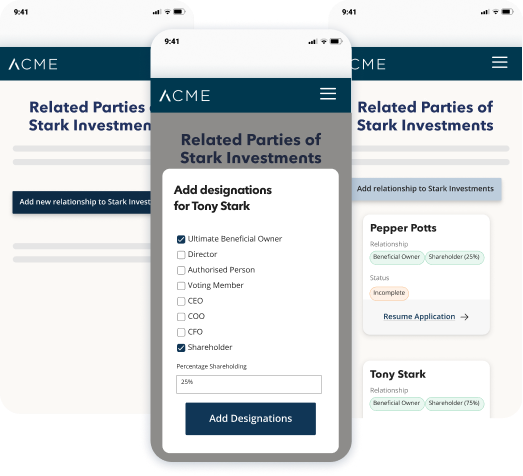
Build the related parties structure
Our software includes an easy-to-use related party builder where you can link and perform FICA on any related parties from authorized persons, to a UBO.
Verification as info is uploaded
While clients upload, the system compares collected info against 3rd party data for address, identity and CIPC information so you can easily confirm the information you have available.
UBO Resources and Training
FREE Downloadable Asset
A Guide to Identifying UBOs
Download our guide to the practical, real-world steps for determining beneficial ownership, from applying the dilution method to screening UBOs and meeting your FICA obligations.
CPD Approved Training · 1 Hour
KYC & Exploring UBOs
Join our 1-hour training session as we unpack the practical, real-world steps for establishing and verifying the identity of your clients, related parties and ultimate beneficial owners.
ARTICLES
FAQs
What is the CIPC Beneficial Ownership Register?
In keeping with addressing deficiencies outlined by the Financial Action Task Force (FATF) and its consequential grey listing of South Africa, the Companies and Intellectual Property Commission (CIPC) has been mandated in terms of the General Laws Amendment Act, the Companies Act and its Regulations to establish a register of Beneficial Owners (BOs) for all entity types registered in terms of the Companies Act and the Close Corporations Acts as amended. There is therefore an obligation for all CIPC registered companies affected by the amendment as per the CIPC’s advice, to declare and register all BOs.
Who are the UBOs of a trust?
For a Trust, which is a specialised entity in terms of ultimate beneficial ownership, you would look to the Donor/Founder to understand where the assets come from, the Trustees to understand who controls the assets, and the Beneficiaries to understand, who will benefit from them.
What documents can be used to verify UBO information?
Given the lack of publicly accessible UBO data in South Africa, it is generally acceptable to request the following documents to verify the UBOs of a company:
- An independently verified or certified company organogram
- Company structure diagrams created or reviewed by an external accountant, auditor, or attorney
- Updated corporate governance documentation
Is the 5% UBO threshold a mandatory legal requirement or just a recommendation?
It’s important to note that while the FIC “strongly recommends” the 5% threshold, the industry expects it to become the de facto standard from now on. Non-compliance with FICA can have significant consequences, ranging from reprimands to substantial fines. In a post-greylisting environment, where South Africa is under increased international scrutiny, the stakes for compliance have never been higher.
How do you calculate the 5% UBO threshold?
When corporate structures involve multiple layers consisting of companies, trusts, as well as individuals, identifying UBOs can become complex. This is where the Dilution Method becomes useful. The Dilution Method uses simple multiplication to determine ultimate ownership through multiple layers. Watch this video to learn more.
Make UBO Verification Simpler for Your Team
Book a short demo to see how nCino KYC helps Accountable Institutions identify, verify and document beneficial owners, from simple structures to multi-layered ones.
